
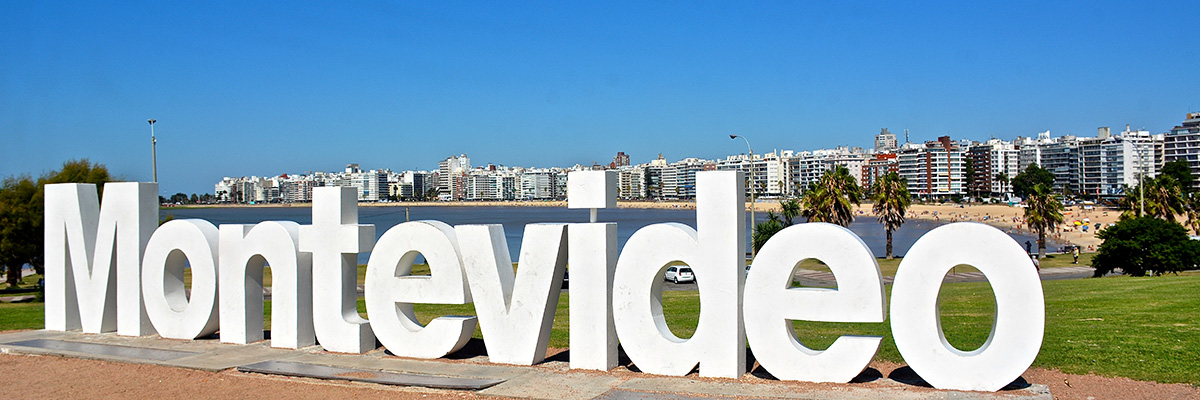
Montevideo Courses – 2027 January - Montevideo & Buenos Aires
Academics
Montevideo is an ideal setting for study because it offers a rich blend of Latin American culture, history, and contemporary society alongside a dynamic business environment. The city also offers rich opportunities for Latin American studies and immersive Spanish language learning. The city's vibrant civic life, diverse communities, and access to regional ecosystems provide hands-on learning that connects classroom study to real-world experiences in culture, society, and sustainability.
You will take one, three-credit course during the January session. Courses are small and meet daily for a minimum of three hours plus homework outside of class. The intimate class size allows for meaningful discussions and close interaction with your professor and other students. No prior knowledge of Spanish is required.
Courses Offered
Course availability is contingent upon scheduling constraints, meeting enrollment minimums, and is subject to change. View course details and descriptions.
Courses marked with an asterisk* are taught in Spanish
January Session
Latin American Culture & Society
- Contemporary Women's Activism
- Cultural History of Argentina and Uruguay
- International Business: Latin America
- Latin America Today*
USAC Course Descriptions
Click the course title to view course details and description. To request a course syllabus: syllabus@usac.edu
- January - Montevideo & Buenos AiresHonors Sociology Women's Studies / Gender Studies 300-level 3 credits Taught in English
This course introduces the notions of gender, women's movements, and digital activism, exploring the current strategies of feminists and women's movements to get together and fight against gender violence of all kinds, using the internet and social networks as powerful tools. The interaction with some of the leading local groups of these new ways of activism will allow the students to discuss these topics firsthand.
- January - Montevideo & Buenos AiresAnthropology History 200-level 3 credits Taught in English
The course introduces the culture of the Rio de la Plata region, specifically Uruguay and Argentina, along with Brazil´s south.
It examines:
• To the 1850s: the pre-conquest native populations; the Spanish conquest and settlement; colonial institutions; Independence movement culture and native heritage in Uruguayan culture.
• From the 1850s to the 1950s: Development of the export economies; democratization; creation of Latin America’s first social welfare state in Uruguay.
• From the 1950s to present: the impact of dictatorship era and the cultural changes.
The course also examines the foundation of Buenos Aires and Montevideo, along with the influences of European populations on the cultural patterns that define the culture of Rio de la Plata. World renowned regional topics such as the gauchos, the mate infusion, tango music, asado, and football (soccer) are also addressed, studied, and presented from a historical-cultural point of view.
- January - Montevideo & Buenos AiresInternational Business Management 300-level 3 credits Taught in English
This course will help students gain a better understanding of the global business environment and enable them to develop effective management strategies across a range of international market environments in Latin America. In particular, we will focus on the role of culture in leadership, communication, motivation, negotiation, decision making, HRM practices, and the management of a multicultural workforce abroad or at home, including management processes at both the macro-level organizational environment and the micro-level environment of culture and human resources. The countries of Latin America, including Costa Rica, Panama, Venezuela, Colombia, Perú, Brazil, and Uruguay, among others each presents a unique personality, necessitating business practices and processes be adapted to this complex and rich cultural diversity.
- January - Montevideo & Buenos AiresPolitical Science Sociology 300-level 3 credits Taught in Spanish
This course will cover topics in modern Latin American society, a region with a vast diversity of people, landscapes, nations, and ethnicities. The emphasis is placed on current challenges and milestones connected to social justice, corruption, democracy, and equality. Students will develop the ability to identify specific events that have taken place in Rio de la Plata in the last twenty years, analyze these events through various theoretical perspectives, and hypothesize its impact on future generations.
Prerequisite: four semesters of college-level Spanish, or equivalent