
Verona Courses – 2026 Summer Session II
Academics
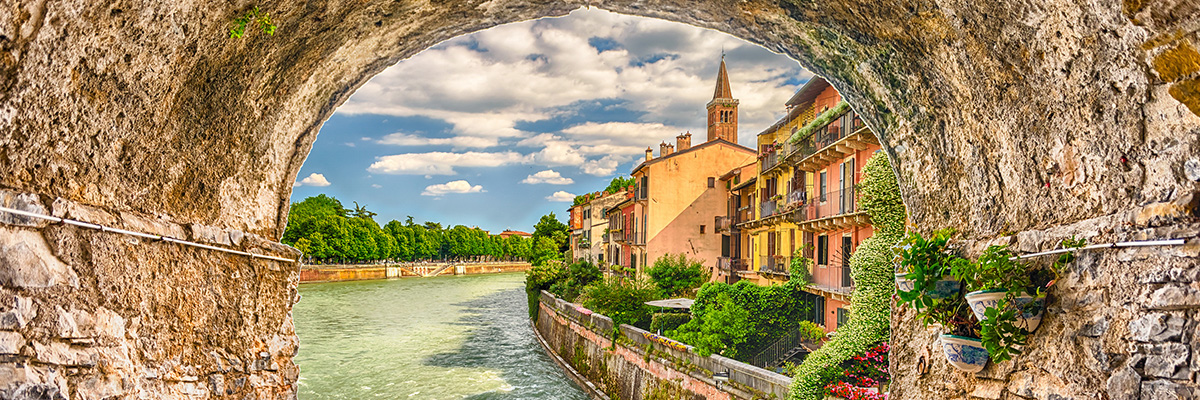
Verona provides an outstanding setting for students to study niche business industries, leveraging its rich cultural heritage and dynamic regional economy. The city serves as a living laboratory for understanding how tradition, local craftsmanship, and modern commerce converge, offering real-world examples of how businesses thrive in a unique and specific environment. As a city steeped in history, Verona also offers unparalleled opportunities to explore Italian culture and art history, from its Roman amphitheater to its medieval architecture and Renaissance art.
You will enroll in three to seven credits during Session I and/or Session II. At least one 3-credit course is required each session you are enrolled. No prior knowledge of Italian is required for the program. A 1-credit introductory Italian course is offered in the summer for students seeking a richer cross-cultural experience.
Courses Offered
Course availability is contingent upon scheduling constraints, meeting enrollment minimums, and is subject to change. View course details and descriptions.
Courses marked with an asterisk* are taught in Italian
Summer Session I
Italian Language and Culture Courses
- Introduction to Italian Language I
- Italian Culture
- Renaissance Art and Architecture
Non-Credit Workshop
- Italian Cuisine
International Business Courses
- Event Management
- Food and Beverage Tourism
- Intercultural Communication
- International Marketing
Summer Session II
Italian Language and Culture Courses
- Introduction to Italian Language I
- Food and Culture
- Shakespeare in Italy
- Roman Art and Architecture: Verona and Veneto Region
Non-Credit Workshop
- Italian Cuisine
International Business Courses
- Digital Marketing
- International Business
- Luxury Brand Management
U.S. Visiting Professors
While most USAC courses are taught by local faculty, the following U.S. professor will also teach in this program:
Summer Session I, 2026
Course: Food and Beverage Tourism
Marketa Kubickova, Ph.D., University of South Carolina
Associate Professor Kubickova has extensive experience in the hospitality industry which has led her to teaching different Management courses. She has been a recipient of Michael J. Mungo Undergraduate Teaching Award and has even curated a course that focuses on international development. As Interim Director of International Affairs, she has a passion for travel and working with students abroad as they embark on becoming global citizens.
Summer Session II, 2026
Course: Digital Marketing
Deepika Naidu, Ph.D., University of Nevada, Reno
Dr. Deepka Naidu is an Assistant Professor of Marketing at the University of Nevada, Reno and has been teaching there since 2023. She received her BA in Business (Global Leadership) and BS in Marketing (Digital & Integrated Marketing Communications) from Arizona State University as well as her MS and PhD in Business Administration (Marketing) from Washington State University. Dr. Naidu previously worked at General Mills, GEICO, and Wells Fargo.
USAC Course Descriptions
Click the course title to view course details, description and availability. To request a course syllabus: syllabus@usac.edu
- Summer Session IIMarketing 400-level 3 credits Taught in English
In this course, students will learn the core pillars of digital marketing, including digital branding, website marketing, search engine optimization, search engine marketing, email marketing, social media marketing, and mobile marketing. Students will develop a comprehensive digital marketing plan using leading industry tools, including artificial intelligence. We will explore European and global best practices, analyze live case studies, and design adaptive strategies. This course prepares students for digital marketing jobs.
- Summer Session IGeneral Business Management 400-level 3 credits Taught in English
Students will explore the fundamental aspects of organizing an event from the start of event operations to successful completion. This course will familiarize students with an overview of the meetings, incentives, conventions, and exhibitions industry. In addition, students will learn the different roles of the organizations and people involved in the event industry businesses.
- Summer Session IGeneral Business Tourism / Hospitality 300-level 3 credits Taught in English
This course explores the multifaceted role of food and beverage in tourism through historical, anthropological, cultural, and business lenses. We’ll delve into culinary tourism’s motivations, cultural impacts, marketing strategies, and the development of food and beverage attractions. Students will engage with local culinary tourism offerings, reflecting on and critiquing their experiences while developing insights into sustainability, cultural identity, and economic impact.
- Summer Session IIAnthropology Nutrition 300-level 3 credits Taught in English
Food is a topic with which every student of every ethnicity has personal experience; it is so common that its cultural connotations tend to be overlooked. Food is often an area related to strong identity, whether positive or negative, of one’s ancestry. Cuisines are not just about sustenance, but also about cultural symbols that bind together people in ritual and as a community. How one participates in the act of eating (when/how) and why certain foods are to be prepared are learned and understood at the table.
This course explores connections between what we eat and who we are through cross-cultural study of how personal identities and social groups are formed via food production, preparation, and consumption. Several films will be used to discuss specific topics, such as festivals/rituals and food as family/community. Moreover, our topics and readings will be eclectic: food taboos; gender and kinship, voice and identity, symbolic and expressive culture, feasts, festivals, fasts, famine, religion and spirituality, race and ethnicity, nationalism, class and social stratification, politics of globalization, among others. Then, we will focus on foodways in Italy, using the tools of anthropology, history, geography, sociology, journalism, and marketing. Furthermore, we will use food as a lens through which to deepen understanding of your new home and neighbors for this term in Verona.
- Summer Session ICommunications 300-level 3 credits Taught in English
The purpose of this course is to develop the skills necessary to build and maintain positive communication and business relationships across cultures. Students will explore the definition, nature and manifestation of culture while examining their own values, traditions, and beliefs. Through active in-class and out-of-class activities, students will learn about the similarities and differences in communication behaviors and explore language usage, nonverbal actions, and perceptions to see how they influence face-to-face communication between individuals of different cultures in the United States, Europe, and the rest of the world.
- Summer Session IIInternational Business Management 300-level 3 credits Taught in English
This course will cover topics related to the challenges of competing in a global economy. Students will acquire knowledge in strategic management in a global competitive environment and develop the ability to effectively analyze how culture impacts motivation, leadership, communication, negotiation, decision-making, HRM practices, and management of a multicultural workforce.
Prerequisite: one semester of college-level business, or equivalent
- Summer Session IInternational Business Marketing 400-level 3 credits Taught in English
This course offers a study of all aspects of marketing unique to international business. We will examine the impact of cultures, ethics, history, politics, and the law on marketing practice in the globalized economy. It also provides knowledge of tools for cultural analysis and discusses issues related to culture, the economy, and all other environmental variables that affect global business. A better understanding of cultural diversity is essential for successful international business, and this course provides a comprehensive perspective.
Prerequisite: Principles of Marketing, Introduction to Marketing, or equivalent
- Summer Session IItalian World Languages and Literatures 100-level 1 credit Taught in English and ItalianSummer Session IIItalian World Languages and Literatures 100-level 1 credit Taught in English and Italian
This course will introduce students to Italian language topics, including a general introduction to everyday vocabulary, grammar, and syntax. Students will learn and practice speaking and pronunciation in groups and with guidance from the instructor.
This course is for students not taking intensive Italian language. It is designed to help students assimilate into the community.
- Summer Session ISummer Session II
For summer sessions: A single-session workshop focusing on a specific skill such as making fresh pasta, pizza, or gelato.
For semesters: A 3-session workshop offering a more structured culinary journey through Italian cuisine exploring different aspects of the culinary tradition.
This workshop is not suitable for students on a gluten-free or vegan diet.
This workshop has an additional fee.
This workshop requires a minimum of 6 students to run.
- Summer Session IAnthropology Italian 200-level 3 credits Taught in English
This course analyzes various aspects of Italian culture through lectures, readings, discussions, and observation research projects. Students will develop an understanding of contemporary Italy, encompassing its recent history, regional differences, social institutions, and contemporary issues. Students will also reflect on their cultural upbringings and beliefs, and to share their Italian culture experiences in class. Students are encouraged to break down commonly held stereotypes and experience the realities of contemporary Italian life.
- Summer Session IIManagement 300-level 3 credits Taught in English
This course explores the strategic management of luxury brands with a particular focus on Italian heritage, craftsmanship, and global market dynamics. Students analyze how leading Italian maisons such as Gucci, Prada, Bottega Veneta, and Valentino build and sustain brand equity, maintain exclusivity, and adapt to digital transformation while preserving their historical and cultural heritage. Through a comparative perspective, the course also examines prominent French maisons, including Louis Vuitton, Dior, and Hermès, as well as major global luxury conglomerates such as LVMH, Kering, and Richemont. The course integrates theoretical frameworks with experiential learning opportunities in and around Verona, a city renowned for its rich artistic heritage, cultural traditions, and longstanding association with premium lifestyle and design.
- Summer Session IArchitecture Art History 300-level 3 credits Taught in English
This course will examine the artistic Renaissance in Italy. It aims to present the birth of Renaissance art from the end of the thirteenth century with the innovative frescoes by Giotto in Assisi and Padua to the significant changes accomplished in Florence by Donatello and Masaccio in the first half of the fifteenth century. Lectures will also present the Renaissance in Rome with the Sistine Chapel's artistic laboratory, Pope Paul III's role in the sixteenth century, and Venetian art – Bellini, Titian, Veronese, Tintoretto - and its influence on Veneto. An accurate selection of this period's most important works of art will allow students to understand why the Renaissance period has been and is still considered a pivotal moment in European art and culture. In addition, students will have the opportunity to experience three field trips to Verona.
The objectives of this course are to understand the Renaissance as a multiform phenomenon through significant examples that illustrate the artistic evolutions through nearly three centuries in Italy. An interactive method will teach students "how" to look at a painting or a sculpture, from the composition to the iconography and its physical and cultural context as well as learn through works of art different artistic techniques, artistic movements, European history, society, politics, and religion. Get excited, have fun, and exchange ideas and opinions.
- Summer Session IIArchitecture Art 400-level 3 credits Taught in English
This course will explore the most important examples of Roman art and architecture in Verona and the Veneto area and give students foundational knowledge of Roman history related to the world of art and architecture. We will use magnificent Verona as our backdrop to learn firsthand about ancient Roman life and culture through the well-preserved examples of art and architecture created in and part of old Roman life and remain as part of the daily life of the Veronese people today in the twenty-first century.
- Summer Session IIEnglish 300-level 3 credits Taught in English
This course examines William Shakespeare’s engagement with Italy through two of his most famous Italian plays, Romeo and Juliet and The Taming of the Shrew. Students will explore how Shakespeare imagined Italy as a landscape of love, loss, and social tensions. Through reading, textual analysis, discussion, film comparison, and performance-based exploration, the course investigates how Renaissance ideas about love, gender, and social expectations continue to resonate in contemporary culture. This course also introduces selected readings from the Divine Comedy by Dante Alighieri and his vision of ideal love—to provide cultural context for Shakespeare’s imaginative setting. Using Verona as a living classroom, students will connect literature, history, and performance.