
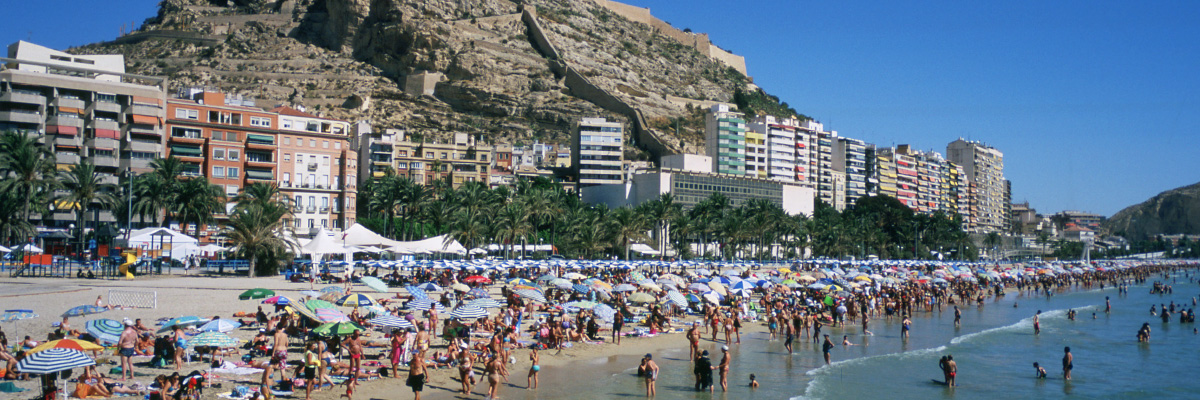
Alicante Courses – 2026 Summer Sessions I & II
Academics
Alicante is the ideal location to study Spanish language and global studies. It offers a full-immersion Spanish-speaking environment, ideal for developing language fluency both inside and outside the classroom. Located on the Mediterranean coast, Alicante has a long history of trade, migration, and cultural exchange. Its unique blend of historical influences — from Roman to Moorish to modern European — offers rich context for exploring global issues like identity, integration, and regional cooperation. Alicante offers a unique opportunity for STEM and engineering students to study in an international context while continuing progress toward their degrees.
You will enroll in three to seven credits in Session I and three to six credits in Session II. At least one 3-credit course is required each session you are enrolled. No prior knowledge of Spanish is required for the program, though taking a language course while you are abroad is encouraged for a richer cross-cultural experience.
Courses Offered:
Course availability is contingent upon scheduling constraints, meeting enrollment minimums, and is subject to change. View course details and descriptions.
Courses marked with an asterisk* are taught in Spanish
Summer Session I:
Spanish Language & Literature
- Elementary Spanish I*
- Elementary Spanish II*
- Intermediate Spanish I*
- Intermediate Spanish II*
- Spanish Composition I*
- Spanish Composition II*
- Advanced Spanish I*
- Spanish Conversation and Oral Skills*
- 20th-Century and Contemporary Spanish Short Story*
Global Studies, Culture & STEM
- Differential Equations
- Economic and Political Institutions of the European Union
- Human Rights and Global Development
- Sailing
- Spanish Culture and Civilization*
- Sustainable Development: Principles and Policies
Summer Session II:
Spanish Language & Literature
- Elementary Spanish I*
- Elementary Spanish II*
- Intermediate Spanish I*
- Intermediate Spanish II*
- Spanish Composition I*
- Spanish Composition II*
- Advanced Spanish I*
- Advanced Spanish Writing and Stylistics*
- Spanish Conversation and Oral Skills*
- 20th-Century and Contemporary Spanish Poetry*
Global Studies, Culture & STEM
- Climate Resilience and Coastal Cities: The Mediterranean
- Intercultural Communication in Professional Contexts
- Sailing
- Spain Today: Politics, Government, and Society
U.S. Visiting Professors
While most USAC courses are taught by local faculty, the following U.S. professors will also teach in this program:
Summer Session II, 2026
Course: Climate Resilience and Coastal Cities: The Mediterranean
Gregory Zaro, Ph.D., University of Maine
Gregory Zaro is an Associate Professor of Anthropology and Climate Change at the University of Maine, with teaching and research interests in millennial-scale urbanization, landscape change, and socioecological resilience among Mediterranean cities. As a Fulbright Scholar, Zaro embraces cultural exchange to build mutual understanding between nations. He is also passionate about student-centered education abroad and prioritizes the integration of research and experiential learning.
USAC Course Descriptions
Click the course title to view course details, description and availability. To request a course syllabus: syllabus@usac.edu
- Summer Session ISpanish 400-level 3 credits Taught in SpanishSummer Session IISpanish 400-level 3 credits Taught in Spanish
This course is designed for students who may manage in daily tasks and interactions, but still need to improve their control over different oral and written registers. In addition, these courses will offer them the opportunity to enhance their vocabulary in specific and technical areas, and to improve grammatical accuracy in their oral and written expression.
Prerequisite: six semesters of college-level Spanish, or equivalent
- Summer Session IISpanish World Languages and Literatures 400-level 3 credits Taught in Spanish
This course is designed to develop students’ written communication and expression skills, and to increase Spanish reading and writing proficiency. Taking the written text as a contextualized communication event addressed to an audience with a clear and defined purpose, class activities are centered around the analysis and understanding of a variety of genres. The highly collaborative classroom environment will also encourage students to ask and answer questions and discuss topics while building Spanish language competency and confidence.
Prerequisite: Six semesters of college-level Spanish, or equivalent
- Summer Session IIAnthropology Geography 200-level 3 credits Taught in English
This course explores the long arc of urban ecological relationships from the Roman era to the present, examining how Mediterranean cities have historically managed water, heat, environmental resources, and risk. Through archaeological, historical, and contemporary perspectives, the course trains students to interpret today’s climate challenges in light of deep temporal patterns, and to envision adaptive strategies for a climate-resilient future of Mediterranean cities. The class combines daily seminars and readings with active and experiential learning exercises, drawing upon Alicante’s contemporary and historic urban landscape to promote place-based observation and cross-cultural learning.
- Summer Session IMathematics 200-level 3 credits Taught in English
Theory and solving techniques for constant and variable coefficient linear equations, a variety of non-linear equations. Emphasis on those differential equations arising from real-world phenomena, particularly in Engineering applications.
Prerequisite: Calculus II (passed with a "C" or better). Calculus III recommended
- Summer Session IEconomics History Political Science 400-level 3 credits Taught in English
This course will analyze the past, present, and future of European integration based on historical, social, political, and economic factors. The process of European integration and its effects will be assessed at the international level considering the EU as well as examining key differences among European member states.
- Summer Session ISpanish 100-level 4 credits Taught in SpanishSummer Session IISpanish 100-level 4 credits Taught in Spanish
This course is designed to help learners of Spanish to develop basic communicative competence and critical thinking skills. It offers an intensive study and practice of the productive and receptive language skills in the oral and written modes. The main emphasis of this track is on communication.
- Summer Session ISpanish 100-level 4 credits Taught in SpanishSummer Session IISpanish 100-level 4 credits Taught in Spanish
This course is designed to help learners of Spanish to develop basic communicative competence and critical thinking skills. It offers an intensive study and practice of the productive and receptive language skills in the oral and written modes. The main emphasis of this track is on communication.
Prerequisite: one semester of college-level Spanish, or equivalent
- Summer Session IGeography Political Science 300-level 3 credits Taught in English
This course introduces the major themes and debates concerning the relationship between human rights and development. The course begins with an examination of the different conceptions of ‘development’, including its evolution in theory, policy, and practice, and its linkages with human rights. Participants analyze the human right to development, which treats development itself as a human right and not just a process which leads to improvement in human rights. The doctrinal and policy implications of adopting a ‘human rights-based approach to development’ based on the ‘right to development’, are discussed along with what such approaches mean, and what are the tools to implement them in the field. Participants will also explore the new streams of critique that have enabled a confluence as well as a questioning of the human rights-development linkages. These include a critical analysis of the successes and failures thus far of the 2030 Agenda for Sustainable Development Goals. The role of strategic litigation in the interface between development and human rights is also looked at with the help of case studies from around the world. In the latter part of the course, selected current issues in the human rights-development interface that are salient from a policy perspective will be examined, including the role of trade, finance, investment, development aid, and aid for trade, why we need to address gender inequalities in the implementation of the SDGs and how climate change is addressed in the 2030 agenda and its inter-relationship with human rights and sustainable development.
- Summer Session IICommunications English 300-level 3 credits Taught in English
This course focuses on fundamental conceptual and practical dimensions of intercultural communication in professional multicultural environments. It aims at developing an individual’s intellectual appreciation for cultural differences and sensitivity regarding intercultural interactions. Effective intercultural communication skills are important in a multicultural society, particularly for those individuals in positions that require effective management of cultural conflicts.
- Summer Session ISpanish 200-level 3 credits Taught in SpanishSummer Session IISpanish 200-level 3 credits Taught in Spanish
This course is designed to help learners of Spanish to develop basic communicative competence and critical thinking skills. It offers an intensive study and practice of the productive and receptive language skills in the oral and written modes. The main emphasis of this track is on communication.
Prerequisite: two semesters of college-level Spanish, or equivalent
- Summer Session ISpanish 200-level 3 credits Taught in SpanishSummer Session IISpanish 200-level 3 credits Taught in Spanish
This course is designed to help learners of Spanish to develop basic communicative competence and critical thinking skills. It offers an intensive study and practice of the productive and receptive language skills in the oral and written modes. The main emphasis of this track is on communication.
Prerequisite: three semesters of college-level Spanish, or equivalent
- Summer Session IRecreation / Physical Education 100-level 1 credit Taught in English and SpanishSummer Session IIRecreation / Physical Education 100-level 1 credit Taught in English and Spanish
This class is co-produced by USAC and “Real Club de Regatas de Alicante”. Students will take ten three-hour sessions to learn the critical components of sailing with experienced teachers. All sailing sessions will take place during the warmer weather months of each semester, i.e., from September through October in the Fall. The class will sometimes meet two times per week. Also, the programmed order of sessions is subject to changes for reasons beyond our control, such as inclement weather, waves, strong rip currents, etc.
This course has an additional fee
- Summer Session IIPolitical Science Sociology 300-level 3 credits Taught in English
This course is an introduction to the historical evolution of Spain and the political, social and economic changes that have shaped modern Spain. The course will examine the successful process that has taken Spain from the isolation and repression under the dictatorship of General Franco to become one of the most advanced and dynamic nations of Europe. Topics covered will include the legacy of Francoism the transition to democracy, the political system, and the economic, social and cultural transformations of Spain. The course will also address the challenges in the economy, job market, welfare state, feminism and the role of women in society, immigration, and youth emancipation.
- Summer Session ISpanish 300-level 3 credits Taught in SpanishSummer Session IISpanish 300-level 3 credits Taught in Spanish
The focus of this course is to improve learners´ written abilities through the analysis and the production of different types of texts. In addition, several grammatical topics will be reviewed in order to enhance and refine the learners´ grammatical competence.
Prerequisite: four semesters of college-level Spanish, or equivalent
- Summer Session ISpanish 300-level 3 credits Taught in SpanishSummer Session IISpanish 300-level 3 credits Taught in Spanish
The focus of this course is to improve learners´ written abilities through the analysis and the production of different types of texts. In addition, several grammatical topics will be reviewed in order to enhance and refine the learners´ grammatical competence.
Prerequisite: five semesters of college-level Spanish, or equivalent
- Summer Session ISpanish 300-level 3 credits Taught in SpanishSummer Session IISpanish 300-level 3 credits Taught in Spanish
Optional three-credit course that complements the development of linguistic competences facilitated at the three-hundred level Spanish courses, focusing in the oral skills in particular.
Prerequisite: Two semesters of college-level Spanish, or equivalent, or instructor approval
- Summer Session IHistory Sociology Spanish 300-level 3 credits Taught in Spanish
This course will develop student understanding of topics related to contemporary Spanish culture and civilization. Students will build a strong theoretical and historical foundation to effectively analyze life in Spain in the present. This course will first introduce historical events during Franco’s dictatorship, the civil war, and the politics of Spain since the late 1970s. Then, students will have the opportunity to evaluate the changes that have taken place in society related politics, religion, economy, society, and LGBTQ rights. This course will also cover topics related to Spanish traditions, regionalism, and nationalism.
Prerequisite: four semesters of college-level Spanish, or equivalent
- Summer Session IEnvironmental Science Geography Political Science 300-level 3 credits Taught in English
This course introduces the main elements of sustainability and its relationship with development and consumption. It provides a perspective of economic and human development in the definitions, scope, and global policies on sustainable development. There is a double focus: analyzing and fully understanding the climate emergency and its impact, on the one hand, and sustainable policies and procedures to set goals (such as SDGs) and measure improvement on the other. The course explores theories and tools for tackling climate change through sustainable consumption.
- Summer Session IISpanish World Languages and Literatures 400-level 3 credits Taught in Spanish
This course focuses on the most relevant authors and great masterworks of Spanish poetry from the last decade of the nineteenth century to the beginning of the twenty-first century in Spain as well as their social, political and historical context. In addition to reading and interpreting the meaning of a broad selection of works, students will develop familiarity with different poetic forms, learn to analyze meter, and will gain fluency in interpreting metaphoric language.
Prerequisite: six semesters of college-level Spanish, or equivalent
- Summer Session ISpanish World Languages and Literatures 400-level 3 credits Taught in Spanish
The objective of the course is to become familiar with outstanding Spanish short-story writers and gain an appreciation for their most important literary works. Additionally, students will learn to conduct a literary analysis of the works read. To facilitate your literary analysis, there will be a series of questions that review content and provide discussion and essay topics.
Prerequisite: six semesters of college-level Spanish, or equivalent