Viterbo Courses – 2026 Fall
Academics
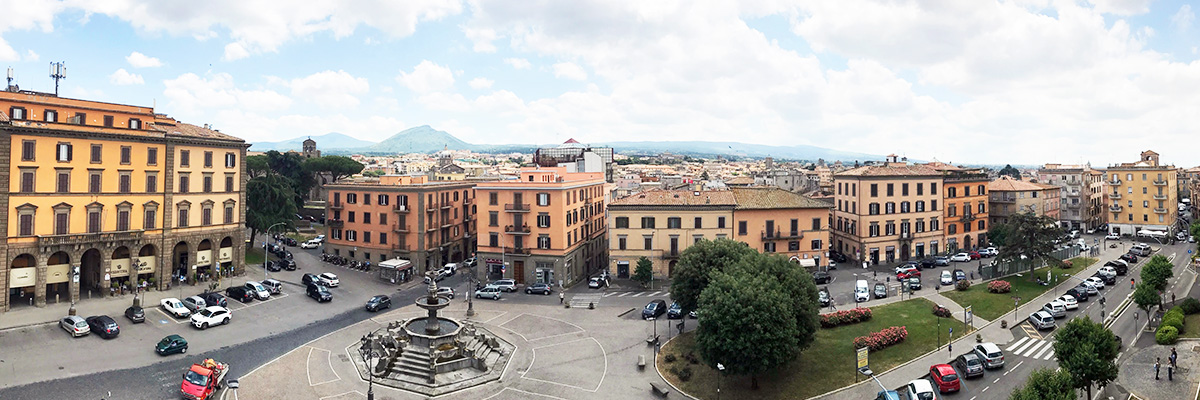
Viterbo offers immersive language learning in an authentic, non-touristy environment. Its rich artistic heritage, including Renaissance and Gothic architecture, provides a living classroom for art history. Surrounded by ancient archaeological sites and papal history, Viterbo is ideal for exploring Italy’s cultural and historical depth firsthand. Daily interaction with native speakers and small class sizes foster rapid language acquisition and deeper cultural understanding.
You will enroll in 12 to 18 semester credits each term, including a minimum of one Italian language course. No prior knowledge of Italian is required to participate in the program. All students take an intensive six-week Italian language course at the start of each semester, which allows for rapid acquisition of language and culture. After the intensive period, you have the option to enroll another language course for further practice.
Courses Offered
Course availability is contingent upon scheduling constraints, meeting enrollment minimums, and is subject to change. View course details and descriptions.
Courses marked with an asterisk* are taught in Italian
Fall Semester
Italian Language & Literature
- Elementary Italian I*
- Elementary Italian II*
- Intermediate Italian I*
- Intermediate Italian II*
- Italian Composition I*
- Advanced Italian I*
- Italian Conversation*
- Survey of Italian Literature I*
- Italian Culture and Society*
Non-Credit Workshops
- Italian Cuisine
Italian Culture & Society
- Contemporary Italian Cinema
- Italian Culture and Society
- Government and Politics in Italy
- Italian History: Italy in the Renaissance
- Music and Identity in Italy
- Roman Civilization
- Sacred Steps: Pilgrimage and Spiritual Walking in Italy
- The Science of the Mediterranean Diet
Art, Architecture, & Art History
- Art Crime: Looting and Restitution in Italy
- Gender and the Arts
- Italian Art: Etruscan and Roman Art
- Museum Studies
- Travel Photography
- Viterbo Sketchbook: Drawing Italy
Internships
Spring Semester
Italian Language & Literature
- Elementary Italian I*
- Elementary Italian II*
- Intermediate Italian I*
- Intermediate Italian II*
- Italian Composition I*
- Advanced Italian I*
- Italian Conversation*
- Survey of Italian Literature I*
- Italian Culture and Society*
Non-Credit Workshops
- Italian Cuisine
Italian Culture & Society
- Economic and Political Institutions of the European Union
- Italian Culture and Society
- Italian History: Italy in the Medieval Era
- Roman Civilization
- Sacred Steps: Pilgrimage and Spiritual Walking in Italy
- The Science of the Mediterranean Diet
Art, Architecture, & Art History
- AI, Cultural Heritage, and the Arts
- Art Crime: Looting and Restitution in Italy
- Documentary Photography
- Gender and the Arts
- Italian Art: Italy in the Renaissance
- Museum Studies
- Spirituality and Architecture in Italy
- Viterbo Sketchbook: Drawing Italy
Internships
USAC Course Descriptions
Click the course title to view course details, description and availability. To request a course syllabus: syllabus@usac.edu
- FallItalian 400-level 3 credits Taught in ItalianSpringItalian 400-level 3 credits Taught in Italian
This course is designed to help students obtain advanced competency in the Italian language. It offers an intensive study and practice of the skills of a language: listening, speaking, interacting, reading, and writing.
Prerequisite: six semesters of college-level Italian, or equivalent
- SpringArt Artificial Intelligence 300-level 3 credits Taught in English
This course explores the intersection of artificial intelligence (AI), digital humanities, and cultural heritage, offering students a thorough and multidisciplinary understanding of how emerging technologies are reshaping the ways we study, preserve, interpret, and communicate cultural heritage. Students will investigate how AI tools, from machine learning algorithms and computer vision to natural language processing and data analytics, are applied across a wide range of contexts, including museums, archives, libraries, visual arts, historical sites, and archaeological collections.
- FallArt History Honors 400-level 3 credits Taught in EnglishSpringArt History Honors 400-level 3 credits Taught in English
This course explores the fascinating and often illicit world of Italian art theft and restitution. Through a critical examination of historical case studies, students will investigate the theft, smuggling, and recovery of Italy’s priceless cultural artifacts. The course will explore the impact of these crimes on cultural heritage, the legal frameworks for restitution, and the ongoing challenges faced by art historians, legal professionals, and governments in the protection and repatriation of stolen art.
Honors-eligible: This course is eligible for honors credit. Membership in your home university Honors program and supplemental honors learning agreement is required to receive honors credit for this course. See USAC Honors page
- FallArt Film Italian 400-level 3 credits Taught in English
This course will identify some of the essential themes and pivotal moments in contemporary Italian cinema since the 1940s. Students will develop a robust theoretical foundation to evaluate various films, including contemporary Italian films, not only identifying their significance as aesthetically valued works, but also as they bear witness to the past.
Prerequisite: one semester of college-level English composition recommended
- SpringArt Historic Preservation Journalism 300-level 3 credits Taught in English
Documentary photography serves to preserve the memory of an object and make it visible, even in its absence. The photographer has the task of documenting cultural heritage and assets in a fair and objective way while also creating new perspectives that provide a better understanding of the work. Each image, without distinction, is more effective for our personal memory than the word, making images a fundamental tool for the documentation of cultural assets.
In this course, we will analyze the visual paths that have created our collective identity. Through the study of the "culture of the gaze,” students will analyze and study a variety of historic monuments - including sculpture and architecture - learning their history, style, origin, author(s), and concepts of restoration as well as the “visual language” of cultural heritage and the use of contemporary tools of image creation such as DSLRs, smartphones and tablets.
To attend the course, you will need a digital camera that allows full manual control of the functions (all DSRL or mirrorless models) with wide-angle and normal lens (18-55 basic lens), and a basic laptop with image software processing (like photoshop, camera raw, lightroom, etc...). Smartphones able to control ISOs, Aperture and Shutter Speed are also allowed.
- SpringEconomics Political Science 300-level 3 credits Taught in English
This course will analyze the past, present, and future of European integration based on historical, social, political, and economic factors. The process of European integration and its effects will be assessed at the international level considering the EU as well as examining key differences among European member states.
- FallItalian 100-level 4 credits Taught in ItalianSpringItalian 100-level 4 credits Taught in Italian
This course is designed to help students acquire basic communicative competence by providing opportunities to develop the basic skills of a language: listening, speaking, interacting, reading, and writing
- FallItalian 100-level 4 credits Taught in ItalianSpringItalian 100-level 4 credits Taught in Italian
This course is designed to help students acquire basic communicative competence by providing opportunities to develop the basic skills of a language: listening, speaking, interacting, reading, and writing.
Prerequisite: one semester of college Italian, or equivalent
- FallArt Women's Studies / Gender Studies 300-level 3 credits Taught in EnglishSpringArt Women's Studies / Gender Studies 300-level 3 credits Taught in English
This course will cover various art-historical topics in ways that reveal the gender inequality that has influenced the art profession throughout history. Students will develop the theoretical and historical foundation to evaluate the gender imbalance in the arts effectively. This course will present neglected artists based on gender and encourage students to develop ideas for creating a more inclusive environment in the art community.
- FallPolitical Science 400-level 3 credits Taught in English
This course will explore critical issues related to Italian politics and its evolution in the European and global context from the end of the World War II until today, including Italian power dynamics in foreign policy and Italy’s role in the European integration process; the Italian constitutional framework and the role and evolution of Italian political parties; elections, the transformation of the political system after 1989, and representation through cinema and media; significant policies put forth by Italian governments, their evolution in Italian society, and their impact on the Italian people and representations in the media; and Italian foreign policy with a comparison to US policy.
- FallItalian 200-level 3 credits Taught in ItalianSpringItalian 200-level 3 credits Taught in Italian
This course offers an intensive study and practice of productive and receptive language skills in the oral and written modes. The course will allow students to improve their knowledge of grammar, increase their vocabulary, and their understanding of cultural and social aspects of Italian life.
Prerequisite: two semesters of college-level Italian, or equivalent
- FallItalian 200-level 3 credits Taught in ItalianSpringItalian 200-level 3 credits Taught in Italian
This course offers an intensive study and practice of productive and receptive language skills in the oral and written modes. The course will allow students to improve their knowledge of grammar, increase their vocabulary, and their understanding of cultural and social aspects of Italian life.
Prerequisite: three semesters of college-level Italian, or equivalent
- FallInternships 300-level 3 credits Taught in EnglishSpringInternships 300-level 3 credits Taught in English
USAC skills-based internships abroad are designed to complement a student’s program of study while providing a structured work or field experience under the direction of a professional supervisor and with the oversight and support of an on-site USAC internship coordinator.
USAC internships facilitate the academic and professional development of students through:
1) the practical application of knowledge and skills learned in the classroom to a professional work environment.
2) the further development of practical competencies essential to the ongoing work of the placement site.
3) the cultivation of a network of professional contacts.
USAC internships will expose students to the workplace culture, norms, and expectations of their respective placement site and host country, deepening cross-cultural understanding and helping students develop intercultural communication and language skills in an internationally focused organization or other professional work setting.
Through the consistent participation in the processes and practices of a professional field, students will acquire a working knowledge of that field and will apply that learning to their own career and academic choices and goals.
This course has an additional fee
- FallArt 300-level 3 credits Taught in English
The course offers an overview of Italian Art through the Etruscan and Roman culture from the early Iron Age (c. 1000 BC) to Late Antiquity (c. 400 AD). Lectures are thematically organized as well as chronologically progressive. The program also provides first-hand knowledge of the art and architecture of this period through on-site visits to archaeological sites, monuments, and museums in Etruria and Rome.
- SpringArt 300-level 3 credits Taught in English
This course will examine the development of Italian art and architecture from the late 14th to the 16th century, focusing on the major artists and architects of the Renaissance in central Italy. Renaissance Italy produced some of the greatest artists in world history, including Donatello, Piero Della Francesca, Leonardo, Raphael, and Michelangelo. Students will study the artwork in its physical and cultural context with visits in and around Viterbo as well as in Rome giving students the opportunity to experience first-hand what is covered in class.
- FallItalian 300-level 3 credits Taught in ItalianSpringItalian 300-level 3 credits Taught in Italian
This course focuses on developing students’ writing and reading abilities through the analysis and production of different types of texts. In addition, several grammatical topics will be reviewed to enhance and refine students’ grammatical competence as well as oral productive and receptive language skills.
Prerequisite: four semesters of college-level Italian, or equivalent
- FallItalian 300-level 3 credits Taught in ItalianSpringItalian 300-level 3 credits Taught in Italian
This course facilitates the language acquisition necessary to express oneself in daily situations and more challenging contexts. Therefore, it will help students become more confident about taking part in conversations in Italian either in everyday life or on a wide range of topics.
Prerequisite: two semesters of college-level Italian, or equivalent
- FallSpring
Each session will begin with a brief introduction to the day's recipes and ingredients, followed by plenty of time to dive into cooking and food preparation. Together, we’ll learn to create classic and modern Italian dishes, including antipasti, pasta, pizza, main courses with veggie sides, and desserts.
Our focus will be on enjoying the experience, with attention to traditional Italian dining customs. Sharing meals together will be one of the best parts of the workshop!
Please note: This workshop is not suitable for students on a gluten-free or vegan diet, as many recipes will feature traditional dishes from all the Regions of Italy.
This workshop has an additional fee.
This workshop requires a minimum enrollment of 9 students to run.
- FallItalian Studies 200-level 3 credits Taught in EnglishFallItalian Studies 300-level 3 credits Taught in ItalianSpringItalian Studies 200-level 3 credits Taught in EnglishSpringItalian Studies 300-level 3 credits Taught in Italian
This course offers a holistic view of Italian culture and society while focusing on important aspects of Italian culture, including food, music, religion, and family, among others. Analyzing these topics will provide students with the necessary tools and concepts to understand Italy as a complex, post-modern society.
- SpringHistory 300-level 3 credits Taught in English
This course will cover topics related to Italian and European Medieval history, from the fall of the Roman Empire to the Renaissance. Students will develop a solid theoretical and historical foundation to effectively analyze the cultures, traditions, social and religious structures that evolved into modern Europe. This course will challenge students to evaluate political, social, cultural, demographic, and economic transformations during the Middle Ages in its various facets in Italy, Europe, and around the Mediterranean. Field trips and firsthand experience include visits to Rome, Tuscania, Viterbo, and other cities.
- FallHistory 300-level 3 credits Taught in English
The Renaissance was a period of great transformation across Europe and the world. Born from the ashes of the devastating plagues of the 14th century, a new era started emerging in the early 15th century. Guiding this transformation were the rediscovery of classical culture, new religious trends, systems of patronage and technological innovations. The rise of a new ‘humanistic’ culture quickly transformed the ways in which society and individuals saw themselves and thought of their relationship with the world. This course examines the changes that Italy underwent from roughly 1350 to 1600, exploring the relationship between a culture that was dismissing its medieval dress to embrace modernity, while social and political struggles still troubled the history of the peninsula, Europe, and the Mediterranean. We will study the origins of social and economic structures, ideas, and mentalities from Renaissance Italy and how these ideas connect to modern western culture. Specific attention will be given to the political and intellectual life in the Renaissance to utilize literary and artistic works as historical sources. The course will also refer to archive documents, architecture, and artworks that are available around Viterbo, between Lazio and Tuscany.
- FallArt History Honors 300-level 3 credits Taught in EnglishSpringArt History Honors 300-level 3 credits Taught in English
This course explores critical debates on museums in society and the core functions of museum practice. This course will take several approaches to studying museums as an interdisciplinary course. Readings and lectures will provide perspectives on such topics as the history and philosophy of museums, types of museums, exhibit design, collections acquisition and management, the staffing and financing of museums, educational programs, and more.
Honors-eligible: This course is eligible for honors credit. Membership in your home university Honors program and supplemental honors learning agreement is required to receive honors credit for this course. See USAC Honors page
- FallAnthropology Music 200-level 3 credits Taught in English
This course introduces students to the connections between music and identity in Italy, exploring how musical practices reflect and shape cultural, regional, and national identities. From the folk songs of Southern Italy to the operatic traditions of Verdi and Puccini, and from postwar singer-songwriters to modern pop and hip-hop, students will examine how music functions as a medium for expression, memory, and belonging. Through readings, listening activities, discussions, and a field visit, students will gain an understanding of Italian musical cultures in their historical and social contexts.
- FallHistory 300-level 3 credits Taught in EnglishSpringHistory 300-level 3 credits Taught in English
In this course, students will study the civilization of ancient Rome as manifested in its history and cultural achievements. Knowledge of the Roman experience is essential for anyone who desires to participate as a self-conscious actor in contemporary Western civilization. Roman history marked a real turning point for the history of the entire Western world, strongly influencing every aspect of life: from society to the economy, from architecture to art, from verbal to figurative language. We owe ancient Rome fundamental models of characters (such as Caesar or Augustus) and entire architectural classes (such as amphitheaters, which have now become stadiums, or basilicas). It is to Rome's credit to have created an impressive social melting pot that has produced today's abundant cultural Western world.
- FallHistory Religious Studies 300-level 3 credits Taught in EnglishSpringHistory Religious Studies 300-level 3 credits Taught in English
This course explores pilgrimage as a dynamic religious and cultural practice from late antiquity to the present. It traces how pilgrimage has evolved into its modern configurations: in some cases, remaining explicitly faith-based and devotional, and in others taking shape as a broader practice connected to European and national and cultural routes. While based in ritual and tradition, contemporary pilgrimage often reflects motivations such as seeking wellbeing or inner balance, connecting with nature, engaging in cultural tourism or physical challenge, and pursuing forms of spiritual reflection outside institutional religion.
This course includes excursions (approximately 2–4 km each) as an integral part of the learning activities. Students are required to wear appropriate clothing for outdoor activities, including comfortable closed-toe shoes (preferably hiking shoes), long pants, mosquito repellent, sunglasses, a hat, a water bottle, and sunscreen.
- SpringArchitecture History Religious Studies 200-level 3 credits Taught in English
This interdisciplinary course explores the relationship between spirituality and architecture in the Italian context, from ancient sacred sites to contemporary religious spaces. Through lectures, site visits, and critical discussion, students will learn how religious beliefs, rituals, and cultural values have shaped architectural forms, urban spaces, and artistic expressions
- FallItalian 300-level 3 credits Taught in ItalianSpringItalian 300-level 3 credits Taught in Italian
This course introduces some of the great writers and thinkers who have shaped Italian literature and culture over a thousand years of history. The selected texts will contribute to an understanding of Italian history, society, and culture through the analysis of the literary movements and the comparison of the most important authors and genres of each period.
Prerequisite: five semesters of college-level Italian, or equivalent
- FallHonors Nutrition 300-level 3 credits Taught in EnglishSpringHonors Nutrition 300-level 3 credits Taught in English
This course explores the Mediterranean Diet from a scientific perspective, integrating nutritional biochemistry, food technology, and public health with the cultural and culinary traditions of the Mediterranean region. Students examine the composition, processing, and health benefits of key Mediterranean foods—such as grains, olive oil, legumes, cheese, meat, fruits, vegetables, and wine—while considering how culture, environment, and lifestyle contribute to one of the world’s most balanced and health-promoting diets.Combining academic study with hands-on experiences, the course takes advantage of the Tuscia region’s rich agricultural heritage and sustainable food systems to connect scientific knowledge with local traditions and practices.
Honors-eligible: This course is eligible for honors credit. Membership in your home university Honors program and supplemental honors learning agreement is required to receive honors credit for this course. See USAC Honors page
- FallArt 300-level 3 credits Taught in English
Photographers, like any other artists, have the responsibility of mediating reality for those who will view their pictures. Travel photography is the quintessential mediation of reality, since people looking at a travel reportage will probably never get to visit the places depicted. The job of travel photographers is then to show their own impressions of a place, representing what caught their attention and what they deemed important, rather than showing famous landmarks.
This course will help you to capture memories, learn to tell a story with images, and give your own impression of a place through photographic expression. In particular, the course will go through the basics of exposure management, getting to know the main features of your camera, managing studio lighting, and understanding composition. The course will also go through the work of the masters of travel photography to encourage students to find their own style of visual expression.
- FallArt 100-level 3 credits Taught in EnglishSpringArt 100-level 3 credits Taught in English
This course is centered on the sketchbook as an instrument for developing drawing and painting techniques and for learning how to observe and understand visual information. Students will use a variety of materials to document historic sites, building up a unique and personal record of the world around them. Individual and group instruction will be provided throughout, and attention will be paid to the progress and needs of each student as they learn the fundamental techniques of perspective and proportion and gain an understanding of the methods that can be used to reproduce a three-dimensional world onto a two-dimensional surface. The course will be structured with in-class activities and outside workshops during which the medieval city of Viterbo will offer a treasure of architecture and artwork that will serve as inspiration.
This course has an additional fee
Host University Courses
Want to experience an Italian classroom? Auditing a course at the Università degli Studi della Tuscia is a great way to meet local students and expand your academic experience abroad. Academic credit may be possible with home university approval. Speak with your Enrollment Specialist for details.