
Chiang Mai Courses – 2026-27 Yearlong
Academics
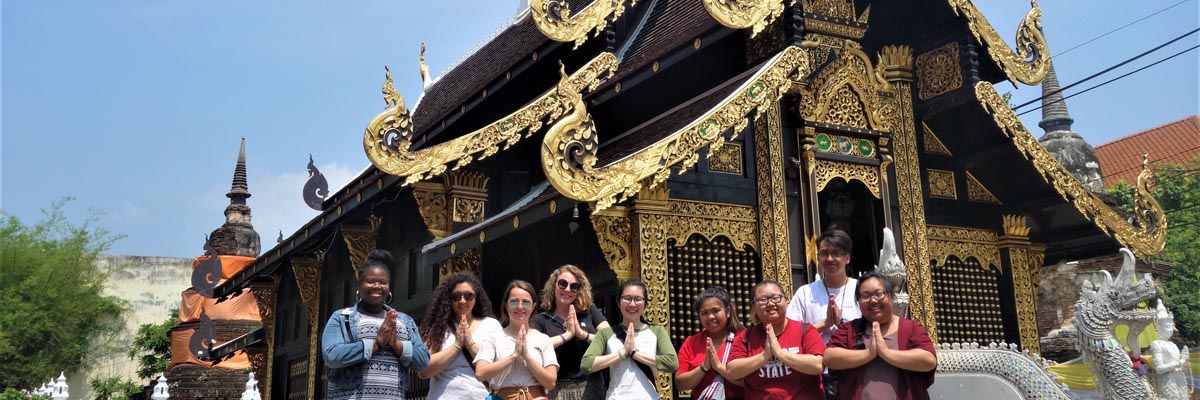
Chiang Mai, long regarded as a cultural and spiritual center of northern Thailand, provides an ideal setting for academic study of mindfulness, public health, and Southeast Asian society. The city’s numerous temples, active monastic communities, and traditions of wellness create unique opportunities to engage with Buddhist thought and health practices in context. As a regional hub with deep historical ties and contemporary connections across Southeast Asia, Chiang Mai also offers valuable insights into the cultural and political dynamics of the region.
You will enroll in 12 to 18 semester credits each term, including a minimum of one Thai language course. No prior language study is required to apply for the program; taking a language course while you are abroad affords you a richer cross-cultural experience.
Courses Offered:
Course availability is contingent upon scheduling constraints, meeting enrollment minimums, and is subject to change. View course details and descriptions.
Fall Courses
Thai Language and Culture Courses
- Introduction to Thai Language I
- Reading and Writing Thai Language I
- Thai Language for Daily Communication I
- Buddhism in Thailand
- Buddhist Art in Thailand
- Thai Society and Culture
Health and Wellness Courses
- Buddhist Psychology: Theories and Applications
- Comparative Studies in Global Healthcare
- Mindfulness and Mindfulness-Based Intervention
- Muay Thai
- Traditional Thai Medicine and Complementary Medicine
Global Studies Courses
- Diplomacy in Southeast Asia
- Gender and Sexuality Studies in Southeast Asia
- Intercultural Communication
- International Political Economy
- Social Entrepreneurship
Internships
Spring Courses
Thai Language and Culture Courses
- Introduction to Thai Language I
- Reading and Writing Thai Language I
- Thai Language for Daily Communication I
- Thai Language for Daily Communication II
- Buddhism in Thailand
- Buddhist Art in Thailand
- Thai Society and Culture
Health and Wellness Courses
- Buddhist Psychology: Theories and Applications
- Comparative Studies in Global Healthcare
- Mindfulness and Mindfulness-Based Intervention
- Muay Thai
- Traditional Thai Medicine and Complementary Medicine
Global Studies Courses
- Governance and Politics in Asia
- Intercultural Communication
- International Business Management
- Peace and Conflict Studies
- Social Movements in Southeast Asia
Internships
USAC Course Descriptions
Click the course title to view course details, description and availability. To request a course syllabus: syllabus@usac.edu
- FallPhilosophy Religious Studies 400-level 3 credits Taught in EnglishSpringPhilosophy Religious Studies 400-level 3 credits Taught in English
This course covers the history and fundamental teachings of the Buddha. Students will develop the theoretical foundation necessary to effectively analyze topics in Buddhist teachings and how Buddhism continues to influence Thai culture and society.
Prerequisite: introductory coursework in college-level religious studies or sociology
- FallArt Religious Studies 300-level 3 credits Taught in EnglishSpringArt Religious Studies 300-level 3 credits Taught in English
This course presents the Buddha's life story and teachings as shown in paintings, sculptures, and other artworks. It explores subjects and themes that frequently appear in Buddhist art and examines the stories and legends of the Buddha and their depiction in Buddhist artworks in different eras and locations. Students will develop a robust theoretical foundation to effectively analyze paintings, sculptures, and architecture of Buddhist monasteries in northern Thailand. The course will provide both a religious setting and cultural context for several major Buddhist art types.
This course has an additional fee
- FallPsychology Religious Studies 400-level 3 credits Taught in EnglishSpringPsychology Religious Studies 400-level 3 credits Taught in English
Mindfulness has become a common word in the Western World, and its practice has become increasingly popular in Western psychology, medicine and psychotherapy, there is a growing interest among professionals and the public in traditional Buddhist systems of neurology, psychology and the healing of the physical and psychological.
This course is designed to put the science and practice of Buddhist Psychology into a Western context for a better understanding of Buddhist psychology, with the intention of a genuine "being in the moment" experience and an understanding of how mind, body and consciousness can embody wisdom, awareness, and loving-kindness which can create a happier, healthier life free from physical, mental and psychological suffering.
Prerequisite: One semester of college-level psychology, or equivalent
- FallCommunity Health Sciences Sociology 300-level 3 credits Taught in EnglishSpringCommunity Health Sciences Sociology 300-level 3 credits Taught in English
This course explores global health issues and the impact of health systems, policies, and international organizations on health and wellness. Students will examine political, environmental, and cultural factors shaping health and wellness globally. This includes the impact health systems have in addressing issues such as health equity, globalization, access to care, and global health challenges like pandemics, disasters, non-communicable diseases, and emerging health threats. The course also delves into the roles of international organizations, non-governmental organizations (NGOs), and governmental agencies in shaping health outcomes. Students will critically assess health systems from a comparative perspective, highlighting both successes and challenges.
- FallPolitical Science 400-level 3 credits Taught in English
This course focuses on the Association of the South East Asian Nations (ASEAN), its achievements and challenges, profiles of its member states, and the role of the Association in building a dialogue and security platform for the Asia-Pacific region.
- FallWomen's Studies / Gender Studies 400-level 3 credits Taught in English
This course focuses on understandings of gender, gender relations, and women’s roles and position in society and culture from sociological and anthropological perspectives. Through feminist theories and movements from the first wave to the present time, various concepts in women studies are explored including sex, gender, sexuality, gender roles, gender inequity, private and public spheres, and gender diversity. Different feminist ideas and debates are also discussed. Emphasis is also given to women in Southeast Asian and Thai societies in various dimensions such as power relations, women’s relationship to the state, politics, development, modernization, globalization, and sexual complexity.
Introductory coursework in sociology or gender studies advised
- SpringGeography Political Science 400-level 3 credits Taught in English
This course aims to facilitate students with fundamental knowledge about the background and developments of governance and politics in Asia. As Asia encompasses more than 60% of the world's population and is home to the most significant regional economic growth, students must gain the tools needed to interpret the phenomena of political movements occurring in the continent. Political geographies of Asia will be discussed and analyzed.
The course will focus on the current most essential actors and their policies and actions that impact the region and the world.
• China – From a secluded empire to the front row of world politics: new dominance in the region and its crucial role in Asia and the World.
• Indian subcontinent – A history of conflicts, nuclear concerns, and threats, new political and economic views of current leaderships, as well as the role of India as an emerging power in the region and the world
• Southeast Asia/ASEAN – A bloc of nations built around a desire for security in the region. It will become the 4/5 largest economy globally by achieving its challenging goals.
• East Asia – Japan and South Korea have a history of antagonism and the need to find a typical road ahead bearing common perils. The role of the USA in backing both countries and their importance in East Asia security and stability.
• Thailand—formerly known as the fifth tiger of Asia. Thailand is considered a nation with turbulent transitions. Thailand has been moving back and forth from authoritarianism to democracy and from democracy to a series of coup d’état.
Students will explore the foreign influence and involvement in the Asian politics of Australia, the European Union, the Russian Federation, and the USA. Then, the course will dive into North Korea and its nuclear threat to security and stability in the region. The One-China Policy and the impact on Taiwan and the South China Sea, Daesh, and other threats in the Middle East, the history of tensions in the Indian subcontinent will also be the object of brief attention, as well as the increasing importance of recent developments in Central Asia and the Caucasus.
- FallCommunications Honors 400-level 3 credits Taught in EnglishSpringCommunications Honors 400-level 3 credits Taught in English
This course focuses on cultural values, beliefs, norms, and biases while exploring how culture influences communication at interpersonal, group, cross-cultural, and global levels. By examining issues such as nationality, race, ethnicity, class, gender, and religion, students will gain a deeper understanding of the factors shaping human interaction across cultures. Through experiential activities, students will not only analyze cultural barriers to effective communication but also apply strategies to overcome these obstacles, fostering their ability to communicate effectively in an increasingly globalized society.
Honors-eligible: This course is eligible for honors credit. Membership in your home university Honors program and supplemental honors learning agreement is required to receive honors credit for this course. See USAC Honors page
- SpringInternational Business Management 400-level 3 credits Taught in English
The environment that corporations operate in has seen dramatic changes in recent years. International management is now a major challenge facing organizations in this current new century. To succeed in this environment, students must now be knowledgeable about the international dimensions of management. This course enables students to expand their knowledge of management and international business in a range of organizations by engaging in practical business tasks, such as preparing business plans, undertaking negotiations and giving presentations. This course has two primary objectives. The first objective is to provide students with an understanding of the international business environment. The second objective is to provide a context in which students can continue to develop their general business skills, such as analysis, strategic decision-making, presentation skills and writing skills.
- FallPolitical Science 300-level 3 credits Taught in English
This course will explore international political economics while situating case studies within the Asian Pacific context. Students will be grounded with theoretical perspectives while learning to adopt a holistic approach with geographical, socio-cultural, and political lenses in examining political and economic development. Such multi-dimensionality is further complemented with an institutional perspective by discussing international organizations and multinational corporations. Finally, the roles of diverse actors in contesting global powers, variegated forms of social movements and other contemporary developments in a dynamic world will be critically explored.
- FallInternships 300-level 3 credits Taught in EnglishSpringInternships 300-level 3 credits Taught in English
USAC skills-based internships abroad are designed to complement a student’s program of study while providing a structured work or field experience under the direction of a professional supervisor and with the oversight and support of an on-site USAC internship coordinator.
USAC internships facilitate the academic and professional development of students through:
1) the practical application of knowledge and skills learned in the classroom to a professional work environment.
2) the further development of practical competencies essential to the ongoing work of the placement site.
3) the cultivation of a network of professional contacts.
USAC internships will expose students to the workplace culture, norms, and expectations of their respective placement site and host country, deepening cross-cultural understanding and helping students develop intercultural communication and language skills in an internationally focused organization or other professional work setting.
Through the consistent participation in the processes and practices of a professional field, students will acquire a working knowledge of that field and will apply that learning to their own career and academic choices and goals.
This course has an additional fee
- FallThai 100-level 1 credit Taught in ThaiSpringThai 100-level 1 credit Taught in Thai
This is a course for students who have not taken any Thai language courses before. Its purpose is to provide students with basic lexical, grammatical, and functional resources to manage in daily situations while studying in Thailand.
Required if not taking 3-credit Thai Language
- FallPsychology 300-level 3 credits Taught in EnglishSpringPsychology 300-level 3 credits Taught in English
Mindfulness meditation and other similar contemplative practices have garnered significant attention from both scholars and practitioners in the past 15 years, especially as it relates to using mindfulness to treat a myriad of psychosocial concerns. This course will introduce students to the concept of mindfulness meditation, specifically as it relates to health, psychology, and other applications through both didactic and experiential learning. Students will study the varied applications of mindfulness-based interventions with special attention given to psychopathology. Students will also be asked to cultivate their own practice of daily meditation/contemplative exercises while also being led by the instructor on various contemplative exercises.
This course has an additional fee
- Fall100-level 1 credit Taught in EnglishSpring100-level 1 credit Taught in English
This course will provide students with an introduction to Muay Thai (the sport of traditional Thai boxing) and its self-defense applications. Students will learn the following movement fundamentals:
• Basic movement
• Basic skills of Punch/ Elbow/ Knee/ Kick/ Push Kick
• Boxing Parent timber of Mae Mai Muay Thai/ Luk Mai Muay Thai
• The tradition of Muay Thai form of homage Wai Kru/ Dress
- SpringPolitical Science 400-level 3 credits Taught in English
This course introduces students to the major themes in the study of peace and conflict. It recognizes the closely interlinked nature of these complex political concepts, and explores the varied modes through which actors have sought to define and explain them. Just as war and other forms of violence and conflict are a constant of human history, so too are ideas and practices that seek the conditions of peaceful (co)existence. We will explore how peace is more than just the absence of war and manifests in different forms in different contexts: just as conflict in global politics is a multi-faceted phenomenon that can (and must) be analyzed from a range of perspectives. The first part of the course introduces students to major theoretical paradigms. The second half engages with key thematics integral to the contemporary study of peace and conflict, with a particular focus on the Southeast Asian region.
Prerequisite: introductory coursework in college-level political science or international relations
- FallThai World Languages and Literatures 100-level 3 credits Taught in ThaiSpringThai World Languages and Literatures 100-level 3 credits Taught in Thai
This is a course for students who are interested in learning Thai orthography, how Thai words are formed and rules for intonations. The purpose of the course is to provide the students (even though they have not taken any Thai language courses before) with basic Thai writing system resources to help them read as well as communicate in daily situations while studying in Thailand.
Co-requisite: Thai Language for Daily Communication I
- FallThai 100-level 3 credits Taught in ThaiSpringThai 100-level 3 credits Taught in Thai
This is a course for students who have not taken any Thai language courses before. Its purpose is to provide the students with basic lexical, grammatical, and functional resources to manage in daily situations while studying in Thailand.
- SpringThai 100-level 3 credits Taught in Thai
This is a continuation course for students who have already taken a Thai language course for beginners. Its
purpose is to enhance the student’s listening and speaking skills in daily situations while studying in
Thailand.
Prerequisite: Thai Language or Daily Communication I, or equivalent
- FallAnthropology 200-level 3 credits Taught in EnglishSpringAnthropology 200-level 3 credits Taught in English
The course aims to equip students with knowledge of Thai society and culture from a critical perspective. It focuses on the historical development of Thailand, particularly the construction of Thainess/Thai nationalism and its effects on Thai self-perception and foreigners’ perception of Thailand.
- FallAnthropology Community Health Sciences 400-level 3 credits Taught in EnglishSpringAnthropology Community Health Sciences 400-level 3 credits Taught in English
This course examines the following: systems of traditional healthcare in Asia; healing modalities widely used in Eastern medicine, use of evidence-based criteria to evaluate the risks and benefits of traditional healthcare, cultural perspectives of herbal medicine, and the botanical/chemical basis of ethnomedicines. Students will develop the foundational skills to utilize Asian healing modalities and herbal medicine. Students will also apply their critical thinking skills to produce a research project related to traditional medicine.
This course has an additional fee