
Lüneburg Courses – 2026 Summer Sessions I & II
Academics
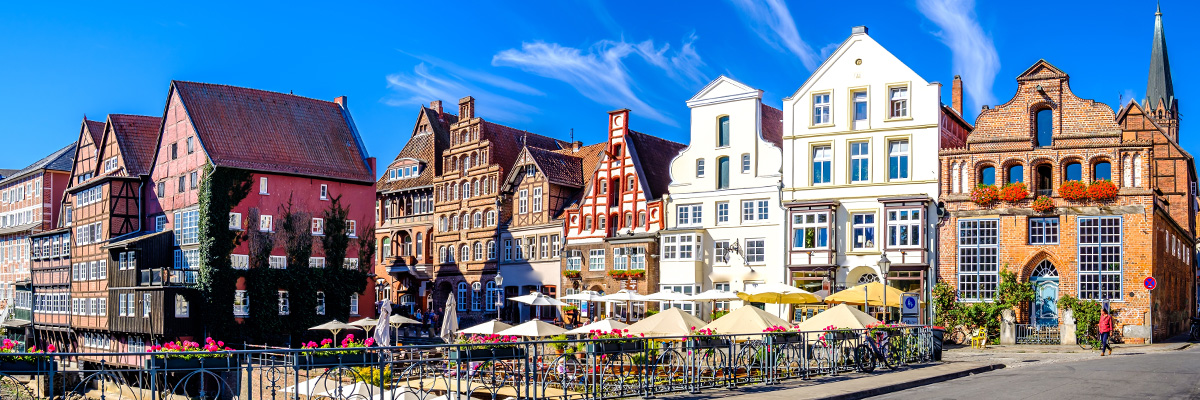
Lüneburg offers an immersive environment for learning German and exploring sustainability. Its walkable, student-friendly layout encourages daily language practice, while local initiatives in renewable energy, green urban planning, and ecological preservation provide real-world context for sustainability studies. The city's rich history and active civic culture also support deeper understanding of German society, politics, and environmental responsibility.
You will enroll in three to seven credits in Session I and/or Session II. At least one 3-credit course is required each session you are enrolled. No prior knowledge of German is required for the program, though taking a language course while you are abroad is encouraged for a richer cross-cultural experience.
Courses Offered
Course availability is contingent upon scheduling constraints, meeting enrollment minimums, and is subject to change. View course details and descriptions.
Courses marked with an asterisk* are taught in German
Summer Session I
German Language Courses
- Elementary German I*
- Intermediate German I*
- German Composition I*
- Advanced German I*
- German Conversation I*
- German Conversation II*
German Society & Sustainability
- 1933-45: Culture, Society, and Politics in Nazi Germany
- German Fairy Tales*
- German-Speaking Europe and its Culture
- Germany's Green Revolution
- Government and Politics in Germany
- Sausages to Sustainability: A Critical History of German Food
Internships
Summer Session II
German Language Courses
- Elementary German II*
- Intermediate German II*
- German Composition II*
- Advanced German II*
- German Conversation I*
- German Conversation II*
- Survival German I*
German Society & Sustainability
- German Culture
- International Business
- Nationalism, Racism, and Diversity in Europe
- Sausages to Sustainability: A Critical History of German Food
- The European Union: Processes, Dynamics, and Structures
U.S. Visiting Professors
While most USAC courses are taught by local faculty, the following U.S. professor will also teach in this program:
Summer Session II, 2025
Course: International Business
Melvin Jameson, Ph.D., University of Nevada, Las Vegas
Professor Jameson is a Professor of Finance Emeritus after 35 years with the University of Nevada, Las Vegas' International Business Association where he regularly encourages students to study abroad. He has gone abroad numerous times to teach both in Costa Rica and Spain. Professor Jameson is passionate about raising student awareness of international business relations.
USAC Course Descriptions
Click the course title to view course details, description and availability. To request a course syllabus: syllabus@usac.edu
- Summer Session IHistory Honors Political Science 400-level 3 credits Taught in English
This course seeks to understand the most infamous two decades of German history, its processes and society, as we look back in history and uncover key moments that likely built the foundation for a totalitarian system of hitherto unknown extremes. Some of these catalysts can be found in traditions and events that transpired within the past 60-100 years. After this introduction of cultural, economic and political factors, special attention will be paid to the impact that these factors had on the daily lives of Germans at the time. This includes antisemitism, gender relations, education, youth culture, resistance movements, and more. Finally, special attention will be paid to the post 1945 period, the foundation of two separate German states, and the way that these two dealt with their past. The course closes with a look at the presence of these topics in unified Germany, with a particular focus on the politics of memory and the memorial culture challenged by the recent surge of right-wing nationalism. The schedule may change due to current events.
Honors-eligible: This course is eligible for honors credit. Membership in your home university Honors program and supplemental honors learning agreement is required to receive honors credit for this course. See USAC Honors page
- Summer Session IGerman 400-level 3 credits Taught in German
This course is designed to improve the knowledge and expressive capabilities of advanced German language students. Students will analyse written text, summarize readings, and practice using new vocabulary in written and oral expressions.
Prerequisite: six semesters of college-level German, or equivalent
- Summer Session IIGerman 400-level 3 credits Taught in German
This course is designed to improve the knowledge and expressive capabilities of advanced German language students. Students will analyse written text, summarize readings, and practice using new vocabulary in written and oral expressions.
Prerequisite: seven semesters of college-level German, or equivalent
- Summer Session IGerman 100-level 4 credits Taught in German
This course is designed for students with no prior knowledge of German. This class introduces German grammar, vocabulary, and pronunciation. Students will learn greetings and useful expressions as well as basic skills in reading, writing, listening, above all, speaking. At the end of the class students will be able to engage in simple conversations with native speakers and navigate German speaking towns and cities.
- Summer Session IIGerman 100-level 4 credits Taught in German
This class introduces German grammar, vocabulary, and pronunciation. Students will learn greetings and useful expressions as well as basic skills in reading, writing, listening, above all, speaking. At the end of the class students will be able to engage in simple conversations with native speakers and navigate German speaking towns and cities.
Prerequisite: one semester of college-level German, or equivalent
- Summer Session IGerman 300-level 3 credits Taught in German
This course is designed to improve the knowledge and expressive capabilities of German language students. Students will analyse written text, summarize readings, and practice using new vocabulary in written expressions.
Prerequisite: four semesters of college-level German, or equivalent
- Summer Session IIGerman 300-level 3 credits Taught in German
This course is designed to improve the knowledge and expressive capabilities of German language students. Students will analyse written text, summarize readings, and practice using new vocabulary in written expressions.
Prerequisite: five semesters of college-level German, or equivalent
- Summer Session IGerman 200-level 1 credit Taught in GermanSummer Session IIGerman 200-level 1 credit Taught in German
This course will improve intermediate language students' knowledge, listening, and expressive capabilities. Students will learn necessary vocabulary to express themselves in daily situations and navigate more complex situations through conversation and free discussion of contemporary topics, using visual material, listening comprehension exercises, and articles from German newspapers and magazines.
Prerequisite: two semesters of college-level German, or equivalent
- Summer Session IGerman 300-level 1 credit Taught in GermanSummer Session IIGerman 300-level 1 credit Taught in German
This course will improve intermediate language students' knowledge, listening, and expressive capabilities. Students will learn necessary vocabulary to express themselves in daily situations and navigate more complex situations through conversation and free discussion of contemporary topics, using visual material, listening comprehension exercises, and articles from German newspapers and magazines.
Prerequisite: four semesters of college-level German, or equivalent
- Summer Session IIAnthropology Political Science 200-level 1 credit Taught in English
This class offers an introduction to German culture, history, geography, contemporary topics, and events in German society and politics. Students will develop a historical and theoretical foundation for effectively analyzing the impact of historical events on German cultural values.
- Summer Session I300-level 1 credit Taught in German
This course will cover fairy tales collected by the Grimm brothers in the eighteenth and nineteenth centuries. Students will learn about the structure of German fairy tales, develop proficiency in grammar, vocabulary, and expressions. Students will also be introduced to the elements of German fairy tales such as fantasy, magic, horror, and romance.
Prerequisite: four semesters of college-level German, or equivalent
- Summer Session IGerman 200-level 3 credits Taught in English
This course entails an introduction to the culture and civilization of German-speaking Europe (Germany, Austria, and Switzerland) in terms of historical and contemporary political perspectives. Students will explore the characteristics and the customs of German-speaking Europeans through readings and class discussions, but especially by observing daily life.
- Summer Session IEnvironmental Science Geography 300-level 3 credits Taught in English
This course examines Germany’s Energiewende (“energy transition”) as a comprehensive case study in climate and energy policy. Germany’s attempt to transform its energy system while maintaining economic competitiveness, social acceptance, and energy security provides a unique lens through which to study contemporary environmental governance. The course traces the historical origins of the Energiewende, examines key policy instruments such as renewable energy support schemes and the nuclear phase-out, and evaluates current climate policies of the German government. While the course focuses on Germany, it also situates the Energiewende within a broader European and transatlantic context, allowing students to reflect on lessons, limits, and transferability of climate and energy policies.
- Summer Session IPolitical Science 400-level 1 credit Taught in English
The purpose of this course is to provide an understanding of contemporary German politics. After a short overview of German history, the course will place emphasis on governmental institutions and policy making within the German polity as well as the political culture and the various political, social, and economic actors involved in the process.
- Summer Session IGerman 200-level 3 credits Taught in German
This course is designed to teach students the fundamentals of German, focusing on listening, speaking, reading, and writing skills through active preparation for/and participation in classroom activities. Grammar and vocabulary are taught in the context of modern German culture in an immersive environment.
Prerequisite: two semesters of college-level German, or equivalent
- Summer Session IIGerman 200-level 3 credits Taught in German
This course is designed to teach students the fundamentals of German, focusing on listening, speaking, reading, and writing skills through active preparation for/and participation in classroom activities. Grammar and vocabulary are taught in the context of modern German culture in an immersive environment.
Prerequisite: three semesters of college-level German, or equivalent
- Summer Session IIInternational Business Management 300-level 3 credits Taught in English
This course will cover topics related to the challenges of competing in a global economy. Students will acquire knowledge in strategic management in a global competitive environment and develop the ability to effectively analyze how culture impacts motivation, leadership, communication, negotiation, decision-making, HRM practices, and the management of a multicultural workforce.
- Summer Sessions I & IIInternships 300-level 3 credits Taught in English
USAC skills-based internships abroad are designed to complement a student’s program of study while providing a structured work or field experience under the direction of a professional supervisor and with the oversight and support of an on-site USAC internship coordinator.
USAC internships facilitate the academic and professional development of students through:
1) the practical application of knowledge and skills learned in the classroom to a professional work environment.
2) the further development of practical competencies essential to the ongoing work of the placement site.
3) the cultivation of a network of professional contacts.
USAC internships will expose students to the workplace culture, norms, and expectations of their respective placement site and host country, deepening cross-cultural understanding and helping students develop intercultural communication and language skills in an internationally focused organization or other professional work setting.
Through the consistent participation in the processes and practices of a professional field, students will acquire a working knowledge of that field and will apply that learning to their own career and academic choices and goals.
This course has an additional fee
- Summer Session IIAnthropology History Honors Political Science 300-level 3 credits Taught in English
With new state-formation, democratization processes and economic transformation in Western Europe, a (re-) emergence of collective identities constructed along cultural, ethnic and religious lines across state boundaries can be observed. They have the inherent potential for profound processes of renewal as well as for violent conflicts. How do specific ethnic and religious groups, society and politics react? What are existing patterns for managing diversity and what new policy models and programs for management of cultural and social pluralism emerge? What happens to minorities involved in these change processes? In this class students will debate diversity and conflict in civil society to get a better understanding for peaceful and democratic decision-making.
Honors-eligible: This course is eligible for honors credit. Membership in your home university Honors program and supplemental honors learning agreement is required to receive honors credit for this course. See USAC Honors page
- Summer Session IHistory Nutrition 300-level 3 credits Taught in EnglishSummer Session IIHistory Nutrition 300-level 3 credits Taught in English
This course explores German history and culture through the lens of food, from prehistoric subsistence to contemporary globalized cuisine, examining how geography, religion, social change, war, industrialization, and migration shape everyday eating practices and regional identities in Germany. Experiential activities and field trips connect historical themes to present-day food culture in northern Germany.
- Summer Session IIGerman 100-level 1 credit Taught in German
The objective of the course is to facilitate the acquisition of basic language patterns and pronunciation necessary to express oneself in daily situations. The class will deal with different conversational themes such as situations at the university, during lunchtime, telephone conversations, at the train station, travel agency, etc. Students will have the opportunity to practice language skills through in-class games and listening exercises. Students will also learn key daily vocabulary for navigating the city.
- Summer Session IIEconomics Political Science 400-level 3 credits Taught in English
The course provides a general introduction to the European Union. Students learn about political theories of integration and study how scholars explain the establishment of the EU and its impact on the nation states and their economies. After examining the history of European integration and the political and economic context in which it developed, we cover the main institutions and their role in day to day politics. In the final part of the class, we analyze core EU policies, such as security, trade, social and economic policies.