
Chengdu Courses – 2027 Spring
Academics
Chengdu provides an ideal setting for advancing Chinese language proficiency through daily immersion in a city known for its approachable dialect and strong educational resources. At the same time, its historical significance as a cultural and economic hub provides rich material for examining how China’s past shapes its present. Chengdu’s dynamic contemporary arts, cuisine, and urban development make it an ideal setting to examine China’s evolving modern culture.
You will enroll in 12 to 18 credits each term, including a minimum of one Chinese language course. If you're interested, USAC's flexible Language Track lets you take up to three language courses — making it possible to complete a year-and-a-half of Chinese in a single semester.
Courses Offered:
Course availability is contingent upon scheduling constraints, meeting enrollment minimums, and is subject to change. View course details and descriptions.
Courses marked with an asterisk* are taught in Chinese
Fall Semester
Chinese Language Courses
- Elementary Chinese I*
- Elementary Chinese II*
- Intermediate Chinese I*
- Intermediate Chinese II*
- Advanced Chinese I*
- Advanced Chinese II*
- Advanced Chinese III*
- Advanced Chinese IV*
Advanced Chinese V through Advanced Chinese X are available as a guided tutorial on request
Chinese Culture and Society Courses
- Ancient Chinese History
- Chinese Economy
- Chinese Popular Culture
- Environmental Sustainability in China
- Food and Culture
- Modern Chinese Society
- Tai Chi
- Tibetan Culture and Society
- Traditional Chinese Medicine
- Visual Arts of China
Non-Credit Workshops
- Sichuan Cuisine
Spring Semester
Chinese Language Courses
- Elementary Chinese I*
- Elementary Chinese II*
- Intermediate Chinese I*
- Intermediate Chinese II*
- Advanced Chinese I*
- Advanced Chinese II*
- Advanced Chinese III*
- Advanced Chinese IV*
- Level 4 HSK Examination Preparation*
Advanced Chinese V through Advanced Chinese X are available as a guided tutorial on request
Chinese Culture and Society Courses
- China's Ethnic Groups: Cultures, Societies, Economies
- Chinese Literature in Movies: From the Beginning to 1949
- Environmental Sustainability in China
- Food and Culture
- Government and Politics in China
- Modern Chinese History
- Religion and Philosophy in China
- Tai Chi
- Traditional Chinese Medicine
- Visual Arts of China
Non-Credit Workshops
- Sichuan Cuisine
USAC Course Descriptions
Click the course title to view course details, description and availability. To request a course syllabus: syllabus@usac.edu
- FallChinese 300-level 3 credits Taught in ChineseSpringChinese 300-level 3 credits Taught in Chinese
This course is for the third-year students of the modern Chinese language and the equivalent (i.e., those who have completed primary Chinese language at the elementary and intermediate level). This course is designed to develop further the students’ listening comprehension, speaking skills, grammar, reading and writing proficiency in Chinese. Various activities - discussions, oral presentations, conversions - will provide the opportunity to practice speaking and listening. Class participation is therefore essential. In addition, outside classroom activities such as shopping, going to a restaurant, interviewing people according to the given topics are included.
Prerequisite: four semesters of college-level Chinese, or equivalent
- FallChinese 300-level 3 credits Taught in ChineseSpringChinese 300-level 3 credits Taught in Chinese
This course is for the third-year students of the modern Chinese language and the equivalent (i.e., those who have completed primary Chinese language at the elementary and intermediate level). This course is designed to develop further the students’ listening comprehension, speaking skills, grammar, reading and writing proficiency in Chinese. Various activities - discussions, oral presentations, conversions - will provide the opportunity to practice speaking and listening. Class participation is therefore essential. In addition, outside classroom activities such as shopping, going to a restaurant, interviewing people according to the given topics are included.
Prerequisite: five semesters of college-level Chinese, or equivalent
- FallChinese World Languages and Literatures 400-level 3 credits Taught in ChineseSpringChinese World Languages and Literatures 400-level 3 credits Taught in Chinese
This course explores contemporary Chinese society through in-depth reading, discussion, and analysis. Students will engage with the content from an analytical, critical, and discursive perspective—focusing on formal writing, structured debate, and academic vocabulary building. Authentic supplementary materials (news articles, video clips, opinion pieces) will be integrated to enhance contextual understanding.
Prerequisite: six semesters of college-level Chinese, or equivalent
- FallChinese 400-level 3 credits Taught in ChineseSpringChinese 400-level 3 credits Taught in Chinese
This course explores contemporary Chinese society through in-depth reading, discussion, and analysis. Students will engage with the content from an analytical, critical, and discursive perspective—focusing on formal writing, structured debate, and academic vocabulary building. Authentic supplementary materials (news articles, video clips, opinion pieces) will be integrated to enhance contextual understanding.
Prerequisite: seven semesters of college-level Chinese, or equivalent
- FallHistory 400-level 3 credits Taught in English
This course will cover topics related to Chinese history, from the origination of Chinese civilization to the early 1600s. Students will examine the evolution and development of different ethnic groups and the tradition, culture, philosophical thoughts, political organizations, social structures, economic situations, religious practice, and foreign relations in ancient China.
Prerequisites: one semester of college history
- SpringAnthropology Honors Sociology 300-level 3 credits Taught in English
This course provides a comprehensive introduction to Chinese ethnic society, economy, and culture, exploring the rich social, economic, cultural, and religious diversity of China's ethnic groups. It particularly focuses on the geo-economic conditions of ethnic regions in China, with an emphasis on Southwestern China. Key topics include the demographic distribution of ethnic populations, urban migration trends, social structures, and interethnic interactions within Chinese ethnic societies. The course also delves into the traditional ecological wisdom of ethnic communities and the development of traditional industries in Southwestern China. Additionally, it offers comparative insights by examining aboriginal experiences in Canada, with contributions from elders and ethnic elites.
Honors-eligible: This course is eligible for honors credit. Membership in your home university Honors program and supplemental honors learning agreement is required to receive honors credit for this course. See USAC Honors page
- FallEconomics General Business 400-level 3 credits Taught in English
Students will apply theories to various Chinese economic policies and complete a historical examination of China’s economic development with a special emphasis on its varying development strategies, and its prospects. This course is designed to create a space for students to discuss and debate difficult topics within economic development and Chinese economic policies.
Prerequisites: Introductory-level economics or economic theory course recommended
- SpringChinese World Languages and Literatures 200-level 3 credits Taught in English
This course teaches Chinese literature from a very specific perspective, movies. Many masterpieces of Chinese literature have been adapted into movies. Moreover, there are also films representing lives of outstanding Chinese writers and the eras when they lived and composed. Therefore, movies and films can be a very intensive and integrated approach for students to learn and understand Chinese literature. Based on the history of Chinese literature, this course will firstly draw a survey of the development of Chinese literature from its beginning to 1949. Then, important literary works and distinguished writers will be highlighted by more careful analysis. On this level, reading of literary works and other references are required and indispensable; meanwhile, related movies and films will be introduced into class too. Discussions towards both the literary works and movies will be encouraged. By this means, the final target of this course is to help students to establish a more comprehensive command of Chinese literature.
- FallAnthropology Chinese Sociology 200-level 3 credits Taught in English
This course focuses on Chinese popular culture from the twentieth century to the present day. From the arrival of Jazz and cinema in China to the global influence of Chinese video games and social media, you'll explore how traditional Chinese elements interact with modern innovations to shape a dynamic and evolving cultural landscape. Beyond the trends, this course also explores the power of intercultural communication in understanding China’s global cultural footprint. Discover how cultural exchanges, stereotypes, and misunderstandings influence the way Chinese pop culture is consumed worldwide and learn how to engage in meaningful cross-cultural dialogue.
- FallChinese World Languages and Literatures 100-level 4 credits Taught in ChineseSpringChinese World Languages and Literatures 100-level 4 credits Taught in Chinese
This introductory course in Modern Standard Chinese (Mandarin) language is designed for beginners of Chinese study. It aims to develop the student’s functional language ability—the ability to use Mandarin Chinese in linguistically and socially appropriate ways. Emphasis is laid on training students in the four language skills, namely, listening, speaking, reading and writing, where speaking takes the lead. Various classroom activities, teacher-guide or students-centered, such as questions and answers, roll playing, pattern skills, dialogues, and oral presentations, provide the opportunity to practice speaking and listening.
- FallChinese World Languages and Literatures 100-level 4 credits Taught in ChineseSpringChinese World Languages and Literatures 100-level 4 credits Taught in Chinese
This introductory course in Modern Standard Chinese (Mandarin) language is designed for beginners of Chinese study. It aims to develop the student’s functional language ability—the ability to use Mandarin Chinese in linguistically and socially appropriate ways. Emphasis is laid on training students in the four language skills, namely, listening, speaking, reading and writing, where speaking takes the lead. Various classroom activities, teacher-guide or students-centered, such as questions and answers, roll playing, pattern skills, dialogues, and oral presentations, provide the opportunity to practice speaking and listening.
Prerequisite: one semester of college-level Chinese, or equivalent
- FallEnvironmental Science Geography 300-level 3 credits Taught in EnglishSpringEnvironmental Science Geography 300-level 3 credits Taught in English
This course examines China’s approach to sustainable development amid rapid economic growth, environmental degradation, and global climate commitments. Drawing on the framework of sustainable development and the concept of ecological civilization, students analyze major environmental challenges including air, water, and soil pollution; energy transition; environmental inequality; and urban sustainability, as well as the policy, technological, and financial instruments used to address them. Through lectures, discussions, case studies, and field-based learning, students critically evaluate China’s sustainability pathways and their implications for global environmental governance.
- FallAnthropology Nutrition 300-level 3 credits Taught in EnglishSpringAnthropology Nutrition 300-level 3 credits Taught in English
This course examines Chinese food culture through a comparative lens that contrasts Chinese and Western cultural traditions. It explores multiple dimensions of culinary culture, including geography, historical development, regional cuisines, folk customs, dining etiquette, and the evolution of the food industry. The course investigates foundational Chinese dietary philosophies such as the principle of “correspondence between humanity and nature” and “dietary therapy for health preservation.” Using a semiotic and sociocultural perspective, students will also analyze how dining practices reflect social hierarchy, collective values, and relational culture embedded within Chinese society.
- SpringPolitical Science 400-level 3 credits Taught in English
This course is designed for students to expand their knowledge of the government and politics of China while developing analytical and research writing skills. It will provide a comprehensive understanding of the Chinese society from 1949 to the present (concentrate on after the Open and Reform Policy). Chinese history, culture, social and political system will be introduced in this class. Methodology includes introduction, discussions, analysis, comparison, and seminars.
Prerequisite: Introductory college-level political science or research writing course
- FallChinese 200-level 3 credits Taught in ChineseSpringChinese 200-level 3 credits Taught in Chinese
This course is for the third-year students of the modern Chinese language and the equivalent (i.e., those who have completed primary Chinese language at the elementary and intermediate level). This course is designed to develop further the students’ listening comprehension, speaking skills, grammar, reading and writing proficiency in Chinese. Various activities - discussions, oral presentations, conversions - will provide the opportunity to practice speaking and listening. Class participation is therefore essential. In addition, outside classroom activities such as shopping, going to a restaurant, interviewing people according to the given topics are included.
Prerequisite: two semesters of college-level Chinese, or equivalent
- FallChinese 200-level 3 credits Taught in ChineseSpringChinese 200-level 3 credits Taught in Chinese
This course is a continuation of Intermediate Chinese I and is designed to further develop the students’ listening comprehension, speaking skills, reading and writing proficiency in Chinese. New grammar points will be introduced, and selected grammar points are reviewed during class sessions. Various activities - discussions, oral presentations, conversions - will provide the opportunity to practice on speaking and listening, class participation is therefore essential.
Prerequisite: three semesters of college-level Chinese, or equivalent
- SpringHistory 400-level 3 credits Taught in English
This course will cover topics related to Chinese history, from the beginning of the Qing dynasty to the present. We will examine the evolution and development of different ethnic groups and the tradition, culture, philosophical thoughts, political organizations, social structures, economic situations, religious practice, and foreign relations in China.
Prerequisites: one semester of college-level history, or equivalent
- FallChinese Honors Sociology 200-level 3 credits Taught in English
Students will evaluate Chinese culture and society by means of a descriptive and analytic survey of chosen topics. While focusing on the cultural and social mainstream of contemporary China, the course also presents and analyzes various historic events, legends, traditions, ancient philosophies, religions and social norms in a sociological and economic perspective so as to enable students to have a better understanding of the evolution of and interactions between the Chinese culture and society.
Field trips to museums and theatre of Sichuan opera are part of the course.
Major topics include but are not limited to the following:
• Social Norms as Reflected in the Chinese Characters
• Taoism, Buddhism, Confucianism and Their Influence on the Chinese Culture and Society
• Chinese Ethnic Minorities
• Education in China
• Sex, Marriage and Family Life in China, Today and the Past
• Family Plan and Birth Control
• Cultural Revolution
• China’s Economic Reform and Opening Up Policies
• Holidays and Traditional Festivals: Their Folkloric Origin and Modern Impacts
Honors-eligible: This course is eligible for honors credit. Membership in your home university Honors program and supplemental honors learning agreement is required to receive honors credit for this course. See USAC Honors page
- SpringPhilosophy Religious Studies 300-level 3 credits Taught in English
This course offers a comprehensive and in-depth survey of the history of Chinese thought and philosophy from the pre-Qin period through the late imperial era (Ming and Qing dynasties), combining close textual analysis with historical contextualization. It introduces students to the major intellectual schools, representative thinkers, and central debates that have shaped China’s philosophical and cultural traditions through critical reading, philosophical interpretation, and analysis of the dynamic relationships among ideas, society, politics, and culture. Students will trace the development of Chinese thought from the “philosophical breakthrough” of the pre-Qin masters, including Confucian, Daoist, Mohist, and Legalist traditions through the synthesis of Confucianism, Yin–Yang theory, and Buddhism in the Han, Wei-Jin, and Tang periods, to the rise of Neo-Confucianism (Lixue) in the Song–Ming era and the emergence of practical learning (Shixue) during the Ming–Qing transition. By the end of the course, students will gain a systematic understanding of the historical trajectory of Chinese philosophy and develop the ability to read, analyze, and discuss classical philosophical texts in English, providing a strong foundation for further study in Chinese philosophy, history, and culture.
- FallSpring
The Sichuan Cuisine workshop offers an immersive experience for students passionate about cooking, providing them the chance to learn about and prepare traditional Sichuan dishes. Sichuan cuisine is a very flavorful regional Chinese cuisine known for its aromatic spices, vibrant chilies, and the unique numbing sensation from Sichuan peppercorns. This workshop combines hands-on cooking, tasting, and some cultural context to help students understand the techniques, ingredients, and stories behind the ingredients and food.
What students will learn:
Key flavors & ingredients: Sichuan peppercorn, dried chilies, doubanjiang (fermented chili bean paste), garlic, ginger, scallion, soy sauce, black vinegar.
Signature techniques: stir-frying, dry-frying, deep-frying and balancing spicy, numbing, salty, sweet, and sour tastes.
Classic dishes (demonstration + tasting): Mapo Tofu, Kung Pao Chicken, Twice-Cooked Pork (or a vegetarian alternative), and Sichuan-style Green Beans.
Hands-on activity: Students will prepare one simple dish in small groups, practicing knife skills, seasoning, and wok technique.
This workshop has an additional fee.
This workshop requires a minimum enrollment of five students to run.
- Fall100-level 1 credit Taught in EnglishSpring100-level 1 credit Taught in English
Taiji (Tai Chi) is also known as a form of “Kongfu,” a traditional Chinese art form and exercise. It is also believed to cultivate Yin and Yang. Zhang Sanfeng and Wang Zongyue are two famous scholars in China who theorized on the benefits of Taiji on the mind, body, and spirit.
This course has an additional fee
- FallAnthropology History Sociology 400-level 3 credits Taught in English
This course will cover topics related to the history and structure that emphasizes the relationship between Tibetan Buddhism or Lamaism and Tibetan Culture. Tibetan Buddhism has shaped its politics, economy, identity, education, and society as central Tibetan civilization. Students will explore how Tibetan culture became a global phenomenon and analyze globalization's impacts on Tibetan culture.
- FallCommunity Health Sciences 400-level 3 credits Taught in EnglishSpringCommunity Health Sciences 400-level 3 credits Taught in English
This course provides a systematic introduction to the fundamental principles of Traditional Chinese Medicine (TCM), examining core theoretical concepts, philosophical foundations, and historical development, along with essential diagnostic methods such as observation, pulse diagnosis, and palpation. The course also introduces key areas including meridian theory, commonly used Chinese medicinal materials, and basic concepts of health preservation and wellness. Through structured instruction and guided practical activities, students will develop a comprehensive understanding of TCM and gain insight into its distinctive medical framework and modes of thinking.
- FallArt Art History 200-level 3 credits Taught in EnglishSpringArt Art History 200-level 3 credits Taught in English
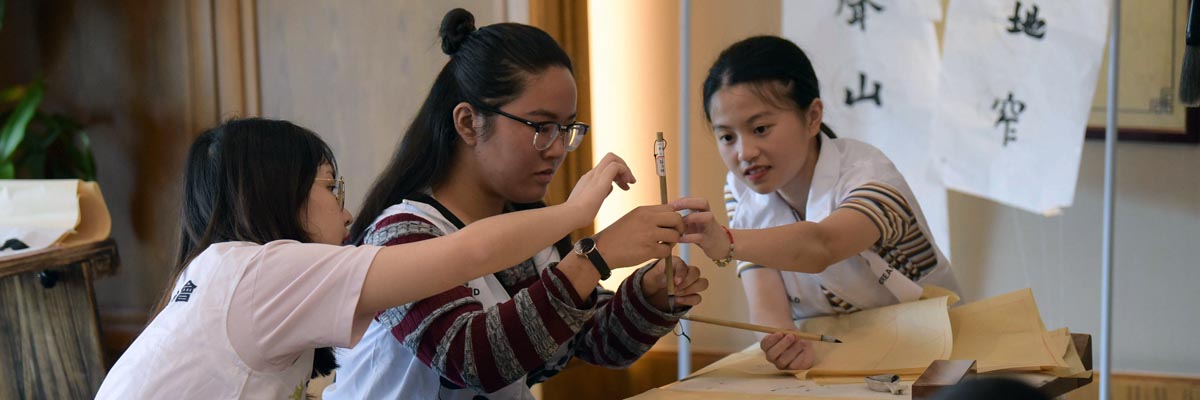
This course offers a systematic exploration of the history and major forms of Chinese visual art, including calligraphy, ceramics, painting, and jade. Students will examine both traditional works and contemporary creative practices, with special attention to hands-on engagement in areas such as large seal script and landscape painting. The curriculum also introduces the use of AI tools to reimagine and extend these artistic traditions. Through guided discussion, critical analysis, and small group seminars, students are encouraged to develop their appreciation, creative skills, and personal perspectives on Chinese artistic heritage.
This course has an additional fee